AI audit trails for verifiable records of decisions and actions.
VeritasChain Standards Organization (VSO) develops VAP, a framework for shared requirements across domains, and domain-specific specifications including VeritasChain Protocol (VCP) for finance.
VAP defines shared requirements. Domain profiles turn them into specifications for each field.
01
Record
Capture decisions, actions and their context.
02
Detect tampering
Use cryptographic proofs to check record integrity.
03
Verify independently
Let third parties examine the recorded evidence.
Cross-domain framework
VAP
v1.2.0 · Draft 3
VAP — Verifiable AI Provenance Framework defines common requirements for AI decision records, including integrity, provenance and traceability. Implementations use domain-specific profiles.
VeritasChain Protocol (VCP) applies the framework to algorithmic and AI-driven trading. Explore the specification, reference implementations and verification demo.
Verifiable Evidence for AI-Assisted Security Research
Design proposal
Informative · non-normative
No released implementation
What was in scope, what was observed, and why was it judged a problem? An application proposal that combines OAP and DAP so the research process can be checked from evidence.
OAP and DAP are Working Drafts registered in VAP v1.2. The proposal adds no profile and sets no requirements, and it states what the evidence alone cannot guarantee.
Tokachi Kamimura founded the VeritasChain Standards Organization (VSO). Through VAP and VeritasChain Protocol (VCP), he works on open standards for verifiable records of AI and algorithmic systems.
Explore his research, technical articles, and development updates on LinkedIn.
Correction — 24 October 2026: the previously displayed totals of 67 authorities and 50 jurisdictions are withdrawn from current promotional claims pending reconciliation with submission records. This is not a finding of zero submissions.
The map and list include historical outreach records under review. The 26 October 2026 announcements describe 26 individually recorded country contacts: 25 sent emails and one acknowledged form submission. Sending, receipt, technical engagement and approval are distinct evidence states.
Submission, receipt, technical response and approval are distinct evidence states.
Outreach around the world
Europe · outreach detail
26 countries contacted on 26 October 2026Historical list · under review
Country and authority names appear below. Colors indicate outreach records, not receipt or approval. Natural Earth
Americas
Europe
APAC + Middle East
Africa
United States
CFTC · SEC
European Union
CEN-CENELEC
United Kingdom
UK-Submissions
Singapore
MAS
Hong Kong
SFC
Australia
ASIC
India
RBI · SEBI · IFSCA
Switzerland
FINMA
UAE
DFSA
South Korea
FSC · FSS
Saudi Arabia
CMA · SAMA
Brazil
CVM · B3
Liechtenstein
TVTG
Canada
OSC · CSA
New Zealand
FMA
Norway
Finanstilsynet
Estonia
FI
Taiwan
FSC
Mexico
CNBV
South Africa
FSCA · SARB
Malaysia
SC · BNM
Indonesia
OJK
Thailand
SEC Thailand
Qatar
QFCRA · QCB
Philippines
BSP · SEC
Israel
ISA · BoI
Chile
CMF
Vietnam
SSC
Turkey
CMB
Egypt
FRA
Bahrain
CBB
Kenya
CMA
Nigeria
SEC
Bangladesh
BSEC · BB
Pakistan
SECP
Kuwait
CMA
Jordan
JSC
Morocco
AMMC
China
CSRC
Argentina
CNV
Colombia
SFC
Peru
SMV
Oman
CMA · FSA
Ghana
SEC
Luxembourg
CSSF
Malta
MFSA · MDIA
Lithuania
BOL · LB
Poland
KNF
Cayman Islands
CIMA
Bermuda
BMA
France
AMF
Italy
CONSOB
Netherlands
AFM
Spain
CNMV
Ireland
Central Bank of Ireland
Sweden
FI
Denmark
Danish FSA
Portugal
CMVM
Czechia
CNB
Slovakia
NBS
Belgium
NBB
Croatia
HANFA
Romania
ASF
Latvia
Latvijas Banka
Hungary
MNB
Iceland
Central Bank of Iceland
Bulgaria
FSC
Greece
Bank of Greece
Cyprus
CySEC
Slovenia
Banka Slovenije
Mauritius
FSC Mauritius
Georgia
NBG
Austria
FMA
Kazakhstan
AFSA · AIFC
Rwanda
NBR / BNR
Sri Lanka
CBSL
Outreach records are being reconciled before totals are restated
Spanning Americas, Europe, Asia-Pacific, Middle East, and Africa
News
Latest Announcements
ANNOUNCEMENT · NEW
VSO updates saved-report checks and Explorer dependencies
Read-only report checks, Explorer dependency updates and clearer legacy-example guidance are now documented. Saved-report consistency and first-party CI do not establish independent reproduction. Experimental extensions remain unadopted.
VSO sends VCP technical briefs to authorities in 8 more countries
On 26 October 2026, VeritasChain Standards Organization (VSO) emailed VeritasChain Protocol (VCP) technical materials to authorities in Cyprus (CySEC), Slovenia (Banka Slovenije), Mauritius (FSC), Georgia (NBG), Austria (FMA), Kazakhstan (AFSA, within the AIFC), Rwanda (NBR/BNR) and Sri Lanka (CBSL). All eight outbound messages were verified in sent-mail records.
The emails shared the VCP specification and published integrity review and limitations, requested routing to the appropriate teams, and invited technical feedback. Austria was contacted through the FMA general mailbox after the dedicated FinTech form repeatedly timed out; formal form acceptance is not confirmed.
Together with the earlier 18-country outreach, today’s individually recorded contacts cover 26 countries: 25 emails and one acknowledged Bank of Greece form submission. Receipt of this latest batch of eight emails and substantive technical review are not confirmed. These are technical introductions, not regulatory approval or endorsement. Historical outreach totals remain under reconciliation.
VSO shares VCP technical materials with authorities in 8 more European countries
On 26 October 2026, VeritasChain Standards Organization (VSO) sent technical information on VeritasChain Protocol (VCP) to authorities in eight additional countries: Belgium (NBB), Croatia (HANFA), Romania (ASF), Latvia (Latvijas Banka), Hungary (MNB), Iceland (Central Bank of Iceland), Bulgaria (FSC) and Greece (Bank of Greece).
Seven emails were verified in sent-mail records. The Bank of Greece confirmed receipt through its FinTech Innovation Hub form. Belgium was contacted through the NBB FinTech email address after the shared FSMA form returned an error. The materials included the VCP specification and the published integrity review and limitations, with a request for routing to the appropriate team and technical feedback.
Together with the earlier ten-country outreach today, these are 18 individually recorded country contacts: 17 emails and one form submission. Receipt of these seven emails and substantive technical review are not confirmed; the Greek form acknowledgement confirms receipt only. No regulatory endorsement or approval is implied. Historical outreach totals remain under reconciliation.
VSO publishes a fixed checkpoint for VCP RTA verifier review
VSO’s own CI completed the published RTA procedure, with 809 regression and 15 separate historical tests per environment. Six selected original JSON records and separate review-intake guidance are now available. This is not a full log archive or another run. The 40-event evidence verdict remains INDETERMINATE; the supplemental format is unadopted and independent reproduction is not established.
VSO sends VCP technical briefs to authorities in 10 European countries
On 26 October 2026, VeritasChain Standards Organization (VSO) sent individual technical introductions on VeritasChain Protocol (VCP) to AMF (France), CONSOB (Italy), AFM (Netherlands), CNMV (Spain), the Central Bank of Ireland, Finansinspektionen (Sweden), the Danish FSA, CMVM (Portugal), the Czech National Bank and the National Bank of Slovakia.
The emails shared the VSO website, the VCP v1.2 specification and the published integrity review and limitations, and requested routing to the appropriate team and technical feedback. Ten outbound emails were checked in the sender’s sent-mail records. Receipt, technical review and endorsement are not confirmed. Earlier outreach totals remain under reconciliation.
VSO publishes VCP research checks and updates implementation status
VSO has published a bounded VCP research candidate for field placement, exact units, time and migration evidence. Internal checks matched 62 bundle and 14 unit expectations, with 39 regression tests passing. Research remains unadopted and independent reproduction unestablished; first-party SDK availability and known issues are reported separately.
Correction — 24 October 2026: the previously published paid-service contract figure and associated commercial details have not been substantiated through reconciliation with primary records. The numerical claim is withdrawn from current public materials pending review; this does not establish a count of zero. No verified contract count, customer count or revenue figure is asserted. Commercial activity is separate from external implementation, independent validation and Evidence Pack acceptance. Previously distributed fixed sources and execution evidence remain unchanged.
VSO releases a reproduction kit for experimental VAP research
The kit brings together execution steps, expected results and reporting templates for a fixed research implementation. Internal checks passed 165 tests and matched 16 OS, 15 gate and 14 verifier cases. The experimental extension remains unadopted; independent third-party reproduction has not been established.
VSO updates Node.js and strengthens VCP Explorer validation
Node.js 24.22.1 is the new baseline. API and GUI type errors have been resolved, and automated checks now stop on lint, build or test failures. The report explains the repository inventory, package-name checks and a VAP-based record of the response.
VSO Publishes a VAP Application Example: Verifiable Evidence for AI-Assisted Security Research
On October 21, 2026, VSO published “Verifiable Evidence for AI-Assisted Security Research”, a VAP application example, in English and Japanese. It is a design proposal and is informative and non-normative: it sets no requirements and does not establish a new profile. The page explains how observation records under OAP (Observed Artifact Provenance, a domain profile) and delegation records under DAP (Delegated Access Provenance, a cross-cutting capability) could be combined so that a third party can check from evidence how AI-assisted security research reached a finding: who delegated what, which rules applied, what was actually retrieved, and how it was assessed. OAP and DAP are Working Drafts registered in VAP v1.2.0 Draft 3. Because their texts are not posted in VSO’s public repositories, the page describes them only as far as the VAP text does and marks its own proposals separately. It also states what the design alone does not guarantee: that observations are accurate, that a vulnerability exists, that the research was authorized or lawful, or that no unrecorded action took place. No implementation of this design has been released.
Site-Wide Review: Outdated and Incorrect Statements Corrected on veritaschain.org
On October 7, 2026, VSO published the results of a review of the pages of this website in English, Japanese and Chinese, extending the October 6 corrections (see below) to the rest of the site. Version and status information now matches the published texts — VCP v1.1 (published) with v1.2 then still a Release Candidate, VAP v1.2.0 Draft 3, CAP v1.0 and CPP v1.4. VCP v1.2.0 has since been tagged General Availability (tag v1.2.0, commit b23acb266f88df81d960d36d58fb64ceaa0dd5ed; GA merged 2026-10-08 JST; fix merged 2026-10-09 JST). That VCP status is separate from VAP v1.2.0 Draft 3 — and schedules whose dates have passed are marked as planned with no date set. Regulatory references were corrected. In particular, MiFID II RTS 25 (Delegated Regulation (EU) 2017/574) was repealed with effect from 2 March 2026 and replaced by Delegated Regulation (EU) 2025/1155; pages that explain the EU clock-synchronization rules now cite the new regulation. Statements that claimed more than the specifications provide, or that implied recognition by a regulator or a standards body, were reworded: records made under VSO specifications are tamper-evident, and conformance does not constitute compliance with any law or regulation. Blog posts and the two whitepaper PDFs are kept as dated records. Each blog post now opens with an editorial note, and statements in the posts about legal requirements and about what VSO specifications do were corrected; each PDF now begins with a one-page correction notice, with its original pages unchanged. Duplicate and leftover pages were removed and broken links repaired. The linked comparison lists the changes. Some items that need a decision by VSO remain under review.
Corrections to VAP v1.2.0 Draft 3 and to This Site: Regulatory References and Capability Language
On October 6, 2026, VSO corrected the published VAP v1.2.0 Draft 3 and current pages of this website after checking them against primary legal sources and the specification's normative text. Appendix D of the specification records six editorial corrections with reasons. Three correct regulatory references: a reference to the revoked US Executive Order 14110 was removed; the EU AI Act provisions cited for medical-device, vehicle, aviation and energy AI were corrected or made specific; and the high-risk application dates under the EU AI Act as amended by Regulation (EU) 2026/1744 were added (2 December 2027 for Annex III systems; 2 August 2028 for Annex I systems). Three revise passages on human oversight, interoperability and omission-evidence that claimed more than the normative text provides. No RFC 2119 requirement, field or conformance level changed. The designation remains v1.2.0 Draft 3; spec/v1.2/README.md lists the SHA-256 digest of each published text. On this site, regulatory references and capability language were corrected in English, Japanese and Chinese; the linked change record lists each change. Dated blog posts, the VCP Explorer application, linked PDF and Word files and versioned program documents were not part of this revision. Review of other statements on this site continues.
VSO Publishes VAP Framework Specification v1.2.0 (Draft 3) on GitHub
On September 28, 2026, VSO published the Verifiable AI Provenance Framework (VAP) Specification v1.2.0, Draft 3, on GitHub. VAP is a metaframework: it defines the common requirements that domain profiles inherit, so that records of AI decisions are auditable, attributable and, at anchor granularity, completeness-verifiable after the fact. It does not prevent, block or intercept any AI behavior. v1.2 makes external anchoring mandatory at every conformance level and adds the Completeness Invariant (INT-008): omission of events after anchoring must be detectable by a third party at batch granularity. Under §1.6, conformance does not constitute compliance with any law or regulation and "does not warrant the correctness, fairness, or safety of the underlying AI decisions — only the integrity, completeness (at anchor granularity), and attributability of their records." The draft is pre-release; it has not been adopted by, and has no standing within, the IETF, ISO/IEC JTC 1/SC 42, ITU-T or any other established standards body. Current status: zero external implementations of VAP or of any VAP profile and zero Evidence Packs accepted in any proceeding. Commercial disclosure update (24 October 2026): the earlier contract figure is withdrawn pending primary-record verification; this does not establish zero contracts. Details The linked text includes the October 6 corrections (see above).
Withdrawn 24 October 2026 — historical headline VeritasChain Co., Ltd. Reaches Ten Paid Client Contracts in Europe
Correction — 24 October 2026: the previously published paid-service contract figure and associated commercial details have not been substantiated through reconciliation with primary records. The numerical claim is withdrawn from current public materials pending review; this does not establish a count of zero. No verified contract count, customer count or revenue figure is asserted. Commercial activity is separate from external implementation, independent validation and Evidence Pack acceptance. Previously distributed fixed sources and execution evidence remain unchanged.
ANNOUNCEMENTJuly 6, 2026
VSO Establishes an AI Research Office in Hokuto, Yamanashi
Effective July 6, 2026, VeritasChain Standards Organization (VSO) has established an AI research office in Hokuto City, Yamanashi Prefecture, Japan — on the southern foothills of the Yatsugatake mountains, about two hours from central Tokyo. The office belongs to VSO, the standards-development organization, not to VeritasChain Co., Ltd., the commercial entity. Its research agenda is deliberately long-horizon: verifiable logging architectures and their real-world failure modes, post-quantum migration for audit-trail infrastructure (ML-DSA / FIPS 204), conformance-testing methodology for cryptographic audit trails, VAP domain profiles beyond finance, and continued alignment with open standards work at the IETF (SCITT / RATS) and the ITU-T. Every output feeds open specifications.
VCP v1.2 Release Candidate Now Available — English, Japanese & Chinese
The VeritasChain Protocol (VCP) v1.2 Release Candidate is now available at github.com/veritaschain/vcp-spec under spec/v1.2/, in English, Japanese, and Chinese. v1.2 is a protocol-compatible, certification-stricter enrichment of v1.1 with zero breaking changes — all v1.0 and v1.1 events and anchors remain valid and verifiable, and the v1.1 hard deadlines (Policy Identification 2026-03-25; Silver external anchoring 2026-06-25) are preserved unchanged. Key additions: strengthened VCP-RECOVERY operational constraints; an ERASURE event type reconciling the GDPR right to erasure (Article 17) with append-only audit trails via crypto-shredding; a version compatibility matrix; SCITT alignment fields; and cross-party (multi-actor) VCP-XREF. The release continues v1.1's alignment with EU AI Act record-keeping (Articles 12, 19, 26, 72) and MiFID II/MiFIR audit-trail requirements. Post-quantum signatures (ML-DSA / FN-DSA) advance to EXPERIMENTAL while Ed25519 remains the default. This is a Release Candidate for public review, not a GA release.
Update: VCP v1.2.0 is General Availability (tag v1.2.0, commit b23acb266f88df81d960d36d58fb64ceaa0dd5ed; GA merged 2026-10-08 JST; fix merged 2026-10-09 JST). This is the VCP release status, separate from VAP v1.2.0 Draft 3.
VeritasChain Standards Organization (VSO) will publish the VeritasChain Protocol v1.2 Public Review Draft (PRD) in the coming days at github.com/veritaschain/vcp-spec. v1.2 is a regulatory-evidence enrichment of v1.1, aligning with EU AI Act Articles 12, 19, 26, and 72; ESMA's February 2026 Algorithmic Trading Supervisory Briefing; and ESMA Q&As 2825 and 2826. All v1.0 and v1.1 anchors remain valid; the v1.1 hard deadlines (PolicyIdentification 2026-03-25; Silver external anchoring 2026-06-25) are preserved unchanged. The PRD ships with JSON Schemas, a Silver/Gold conformance test suite, post-quantum reference vectors, and a CI pipeline. Public Review will run for 45 days. This is a Public Review Draft, not a GA release.
ANNOUNCEMENTApril 13, 2026
VSO Applies to IOSCO TechSprint 2026 on Investor Education in the Age of AI
VeritasChain Standards Organization (VSO) has submitted its application to the inaugural IOSCO TechSprint 2026, powered by the UK FCA AI Lab. Our submission — "VerifyFirst" — combines VeraSnap, our production cryptographic evidence capture app (available on App Store and Google Play across 175 countries), with interactive verification education tools designed to help retail investors identify AI-enabled fraud and demand cryptographic proof from financial platforms. Selected teams will present at Demo Day on October 8, 2026 in Madrid, at the margins of the IOSCO C8 Plenary meeting.
Note — 25 October 2026: VeraSnap is an app of VeritasChain Co., Ltd., the company that operates VSO; it is not a VSO specification. Its availability in app stores is not a claim of conformance to VAP or CPP.
VeritasChain Publishes CAP-SRP Technical Deep Dive
We published a LinkedIn Article detailing how AIMomentz, a first-party platform, implements CAP-SRP — our open specification for tamper-evident AI provenance tracking. The piece covers cryptographic audit trails, refusal logging, and human preference evaluation across GPT, Grok, and Gemini.
Regulatory Clarification Confirms Voluntary Adoption of VeritasChain Protocol (VCP)
VeritasChain Standards Organization (VSO) has received formal regulatory clarification confirming that the VeritasChain Protocol (VCP) operates as a technical audit specification and does not fall within the scope of financial sandbox or licensing frameworks when used as a governance tool. The clarification further confirms that financial institutions may evaluate and adopt VCP within their own internal AI governance and risk management frameworks. VCP is not a regulatory mandate—it is a cryptographic audit infrastructure designed to strengthen algorithmic accountability, tamper-evident recordkeeping, and post-hoc verifiability.
VeritasChain Co., Ltd. today announced the release of VeraSnap v1.5, a cryptographic evidence capture application, alongside the global launch of VeraSnap for Android on Google Play Store.
VeritasChain Publishes CAP Framework Paper on SSRN
VeritasChain Standards Organization (VSO) announces the publication of "CAP: A Cryptographically Verifiable Provenance Framework for Creative and Generative AI Systems" on SSRN. The paper formally introduces CAP (Content/Creative AI Profile), a cryptographic audit framework designed to make AI system behavior independently verifiable.
VeritasChain Submits Policy Input to Japan's Cabinet Office on AI Adoption Barriers
VeritasChain has submitted a formal response to the Cabinet Office of Japan's public call for information on regulations and institutional frictions that may hinder—or fail to adequately support—the social implementation of AI. In our submission, we highlighted a recurring bottleneck in high-risk deployments: the lack of clear, consistent requirements for audit-ready logging and verifiable audit trails.
CAP-SRP v0.1.0 Released: Verifiable Cryptographic Evidence of AI Safe Refusals
VeritasChain Standards Organization (VSO), a vendor-neutral standards organization developing cryptographic auditability standards, today announced the public release of CAP-SRP v0.1.0, an open-source reference implementation that produces independently verifiable evidence that an AI system refused to generate harmful content.
VeraSnap is now available on the App Store and Google Play. A consumer mobile application implementing the Capture Provenance Profile (CPP), VeraSnap enables cryptographically verifiable capture provenance through local processing and third-party timestamp anchoring.
Poland's Leading Prop Trading Review Platform Begins Alignment with VeritasChain Protocol
VeritasChain Standards Organization (VSO), a vendor-neutral standards organization developing cryptographic audit trail standards for algorithmic trading, today announced a collaboration with propfirm.pl, an analytical platform serving the proprietary trading community in Poland. Through this collaboration, propfirm.pl is beginning alignment with VeritasChain Protocol (VCP) concepts by incorporating cryptographic-verifiability criteria into selected parts of its transparency and methodology disclosures, and by publishing educational material to help traders understand independent verification of transaction logs.
VeritasChain Standards Organization (VSO) today announces the forthcoming implementation of a Real-Time VCP Supervision Node Proof-of-Concept (PoC), a supervisory infrastructure enabling financial regulatory authorities to independently verify the integrity of algorithmic trading audit trails through cryptographic Merkle proofs and third-party anchoring.
VSO Completes Chair-Level Dialogue with ITU-T SG17 on AI Trust and Verifiable Evidence
VeritasChain Standards Organization (VSO) has completed a chair-level technical dialogue with ITU-T SG17 to align on scope boundaries and identify practical coordination paths for trustworthy AI. The discussion confirmed a shared no-duplication principle: governance topics such as trust frameworks, digital identity, and control-plane concepts are best handled at the framework level, while protocol-level evidence mechanisms should be addressed through existing Internet standards work. VSO clarified that the Verifiable AI Provenance Framework (VAP) is an informational architectural framework that does not introduce new protocols, and that our domain profiles, including VeritasChain Protocol (VCP), focus on verifiable decision trails, third-party verification, and evidence packaging. VSO will review the materials shared by SG17 and provide concise alignment feedback to support interoperability and avoid overlap across standards bodies.
VeritasChain develops open standards for cryptographically verifiable audit trails in AI-driven and algorithmic systems, enabling independent, post-hoc verification of decision-making processes. Through participation in the Association's activities, VeritasChain will contribute to industry dialogue on transparency, accountability, and regulatory readiness in fintech, while collaborating with stakeholders in Japan and internationally.
ANNOUNCEMENTJanuary 21, 2026
Initial Regulatory Discussion Completed; Next Steps Confirmed
We held an initial discussion with financial supervisory officials overseas to exchange views and clarify scope regarding a previously submitted technical brief. The conversation focused on intent, applicability within the local supervisory structure, and the most appropriate channel for further review. We explained that we are not a trading operator and do not intend to conduct any trading activity. We positioned the initiative as a technical standard and reference implementations for verifiable audit trails, not as a commercial service, client-facing offering, or consultancy engagement. We also clarified that we are not asking regulators to adopt a specific vendor solution or operate any system, and that implementation would typically be carried out by market participants or their chosen vendors. We will provide a concise written document that clearly summarizes our intent, scope, and non-applicable items for internal circulation and routing, after which the supervisory side will determine the appropriate point of contact and follow up after review.
Disclaimer: This note is a summary based on our understanding and does not represent any official position, approval, or endorsement by the other party. It is not intended as an evaluation of, or recommendation regarding, any specific organization or regulatory framework.
ANNOUNCEMENTJanuary 20, 2026
VeritasChain Releases Open-Source Solution for GDPR-MiFID II Compliance Paradox
VeritasChain Standards Organization (VSO) today announced the public release of its VCP v1.1 Crypto-Shredding Proof-of-Concept, an open-source implementation that addresses the long-standing regulatory tension between GDPR data erasure requirements and MiFID II financial record-keeping obligations.
VeritasChain Releases Open-Source Cryptographic Audit Trail for TradingView
The VeritasChain Standards Organization (VSO) today announced the public release of vcp-tradingview-rta-reference, a complete open-source implementation of the VeritasChain Protocol (VCP) v1.1 for TradingView algorithmic trading systems.
VSO Releases CPP v1.0, a Cryptographic Capture Provenance Standard Complementing C2PA
VeritasChain Standards Organization (VSO) has released CPP v1.0 (Capture Provenance Profile), an open specification for cryptographically verifiable media capture provenance. CPP introduces the Completeness Invariant—a mathematical mechanism using XOR hash sums to detect deleted events—addressing a critical gap in existing content authenticity standards. Designed as a privacy-first complement to C2PA, CPP requires external RFC 3161 timestamps to eliminate self-attestation vulnerabilities while keeping location data OFF by default.
VSO Releases VAP Framework, an Open Standard for Verifiable AI Decision Audit Trails
VeritasChain Standards Organization (VSO) has released the VAP Framework (Verifiable AI Provenance), an open standard defining cryptographically verifiable audit trails for AI decision-making systems. VAP establishes a cross-domain foundation for recording, preserving, and independently verifying AI behavior across high-risk sectors. The framework enables regulators, auditors, and system operators to assess AI accountability beyond trust-based explanations.
VSO Releases CAP v1.0, a Verifiable Audit Standard for AI Content Generation
VeritasChain Standards Organization (VSO) announced the release of CAP v1.0, an open technical standard enabling cryptographically verifiable audit trails for AI content generation. The release follows the Grok image incident, which exposed a critical accountability gap in current AI systems: the inability to independently prove what content was—or was not—generated. CAP v1.0 provides tamper-evident logging and third-party verifiability to support regulators, platforms, and auditors worldwide.
VeritasChain Unveils PoC for Verifying Prop Firm Payout Disputes
VeritasChain has released a cryptographic proof-of-concept that enables independent verification of prop firm payout disputes. The PoC demonstrates tamper-evident trading logs and third-party verifiability.
Grok Incident Highlights AI Safeguard Gaps, Driving Demand for Verifiable Non-Generation Evidence
Recent investigations into the Grok image-generation incident have revealed structural limits in current AI safeguard claims, particularly the lack of independently verifiable evidence when content is not generated. In response, VeritasChain has unveiled a cryptographic framework that enables third parties to verify AI non-generation events without relying on internal platform assertions.
VeritasChain Releases CAP-SRP, a Standard to Make AI Content Non-Generation Verifiable
VeritasChain Standards Organization (VSO) announced the release of CAP-SRP (Safe Refusal Provenance), an open standard designed to produce cryptographically verifiable records of AI refusal decisions. CAP-SRP records generation attempts and refusal decisions in a tamper-evident, verifiable format, enabling third parties to verify that requests for prohibited or restricted content were logged as refused.
Cloudflare Workers Power a Verifiable Algo Trading Audit Trail
VeritasChain Standards Organization (VSO) announced a proof of concept demonstrating a cryptographically verifiable audit trail for algorithmic trading using Cloudflare Workers. The implementation records trading events in real time and produces tamper-evident logs that can be independently verified by third parties, without relying on internal system access.
VeritasChain Protocol (VCP) has published a publicly documented evidence pack for NASDAQ OUCH and ITCH market data. The release demonstrates a production-grade, cryptographically verifiable audit trail using real trading protocol messages, enabling independent verification of order lifecycle integrity, timestamps, and event completeness.
VSO Completes Verifiable Audit Trail PoC on IBKR Live Trading
VSO has completed a publicly documented proof-of-concept on Interactive Brokers (IBKR) live trading workflows for a cryptographically verifiable audit trail. The PoC demonstrates how real trading events can be recorded with tamper-evident integrity, enabling independent post-trade verification of execution sequences and system behavior. This milestone shows that cryptographic auditability is feasible in production trading environments.
VeritasChain has released a production-environment Proof of Concept (PoC) demonstrating cryptographically verifiable audit trails for FIX Protocol 4.4 using VCP v1.1. The public evidence pack shows how algorithmic trading events can be recorded with tamper-evident integrity, Merkle-based completeness, and external anchoring, while sensitive fields remain masked. Designed for regulators, auditors, and RegTech/SupTech stakeholders.
VCC Demo v2.0: Tamper Detection & 4-Language Support
Major update to VCC Demo. New features: tamper detection visualization, Merkle tree explorer, live trading simulator. Now supports EN/JA/ZH/ES with dark mode.
Historical announcement; numerical totals remain under review as of 24 October 2026. The original wording below is retained as history, not current substantiation.
VCP Engages 67 Regulators Across 50 Jurisdictions
VeritasChain Protocol (VCP) has expanded its global regulatory engagement to 67 authorities across 50 jurisdictions. Through direct outreach and technical briefings, VCP shares practical evidence of cryptographically verifiable audit trails for AI and algorithmic trading, supporting transparency and accountability in financial markets worldwide.
VeritasChain has released VCP v1.1, introducing an open-source Evidence Pack for verifiable AI and algorithmic trading logs. The update enables third parties to independently verify trading events through cryptographic proofs.
VeritasChain has published a publicly documented cryptographic audit trail for live cTrader trading workflows. The release demonstrates verifiable, tamper-evident logging of real trading events, enabling independent validation of algorithmic execution in production environments.
VeritasChain Completes Field PoC of VCP v1.0, Open-Sourcing a Specification That Makes AI Trading Decisions Verifiable After the Fact
VeritasChain Standards Organization (VSO) today announced the completion of a field proof-of-concept (PoC) for VeritasChain Protocol (VCP) v1.0, and the open-source release of a reference implementation, the VCP Reference Trading Agent (VCP-RTA). The implementation demonstrates how audit trails generated by AI-driven trading systems can be made cryptographically verifiable after the fact, enabling independent post-hoc verification of AI decision-making and execution processes.
26 October 2026 clarification: the announcement above is retained as a historical record. The current RTA review target handles legacy v1.1-labelled evidence; its 40-event verdict is INDETERMINATE. First-party CI is not independent reproduction or tier conformance; the supplemental format remains unadopted. Selected original CI records and their limits →
VSO Publishes CAP v0.1: Content / Creative AI Profile for Verifiable AI Provenance
VeritasChain Standards Organization (VSO) has published CAP v0.1 (Content / Creative AI Profile), a new domain profile under the Verifiable AI Provenance (VAP) Framework. CAP defines a verifiable evidence layer for AI workflows involving content and IP—covering ingestion, training, generation, and export—so that disputes can be examined with cryptographically verifiable records.
VSO Submits Technical Comment on Responsible Use of Generative AI in Japan
VeritasChain Standards Organization (VSO) has submitted a public comment to the Japanese Cabinet Office regarding the responsible use of generative AI. From a technical perspective, the comment emphasizes that transparency and accountability should be supported by mechanisms enabling post-hoc verification, rather than relying solely on policy statements.
ANNOUNCEMENTDecember 25, 2025
VeritasChain Standards Organization Shares Non-Normative Technical Note on Post-Market Monitoring Evidence under the EU AI Act
VeritasChain Standards Organization (VSO), a vendor-neutral technical standards organization, has shared a non-normative technical note via the European Commission's official contact channel and with the CEN-CENELEC JTC 21 Secretariat. The note provides an illustrative technical perspective on evidence integrity considerations for post-market monitoring (PMM) under Article 72 of the EU Artificial Intelligence Act. The document is shared solely as background technical material for informal discussion and does not constitute a proposal, recommendation, or regulatory interpretation.
VeritasChain Standards Organization Shares Non-Normative Technical Input on Verifiable AI Accountability with the OECD
VeritasChain Standards Organization (VSO), a vendor-neutral technical standards organization, today announced that it has shared a non-normative technical input with the Organisation for Economic Co-operation and Development (OECD) for information and technical dialogue purposes.
VeritasChain Standards Organization Shares Non-Normative Technical Note with ETSI TC ESI
VeritasChain Standards Organization (VSO), a vendor-neutral technical standards organization, today announced that it has shared an informational, non-normative technical note with ETSI TC ESI (Electronic Signatures and Infrastructures).
VeritasChain Standards Organization Shares Non-Normative Technical Note with NIST NCCoE on Verifiable AI Audit Evidence
VeritasChain Standards Organization (VSO) announced that it has shared a non-normative technical note with NIST NCCoE, outlining an illustrative approach to cryptographically verifiable AI audit evidence for post-hoc, third-party verification.
VeritasChain Releases VAP Scorecard Explorer v1.2, Introducing Executive Mode for AI Audit Readiness
VeritasChain announces the release of VAP Scorecard Explorer v1.2, introducing Executive Mode to help business leaders and compliance teams assess AI audit readiness without deep technical expertise.
VeritasChain Submits Non-Normative Technical Input on Verifiable AI Audit Logging to ISO/TC 68 JWG 7
VeritasChain Standards Organization submitted a non-normative technical input to ISO/TC 68 JWG 7, providing illustrative input on verifiable AI audit logging for discussion purposes only.
VeritasChain Shares Non-Normative Discussion on Verifiable AI Audit Logs with W3C Credentials Community Group
VeritasChain Standards Organization shared a non-normative discussion topic with the W3C Credentials Community Group on representing verifiable AI audit logs using Verifiable Credentials.
VeritasChain Releases VAP Scorecard Explorer v1.1, Improving Audit Defensibility Through Practitioner Feedback
VeritasChain announces the release of VAP Scorecard Explorer v1.1, a reference implementation update that improves scoring clarity and audit defensibility based on real-world practitioner feedback, without changing the canonical benchmark criteria.
VeritasChain Advances Verifiable AI Governance With IEEE, IETF, and EU AI Act Research Milestones
VeritasChain Standards Organization announces new IEEE and IETF submissions, EU AI Act–focused research publications, and the release of a practical audit scorecard to strengthen third-party verification of AI systems.
VSO Submits Internet-Draft to the IETF on Verifiable Audit Trails for AI Trading
VeritasChain Standards Organization announces the submission of an individual Internet-Draft to the IETF, proposing a SCITT-based profile for cryptographically verifiable audit trails in AI-driven and algorithmic trading systems. The draft is published on the IETF Datatracker to invite open technical discussion.
ANNOUNCEMENTDecember 18, 2025
VSO Publishes DOI-Registered Auditability Research and Enters IEEE Security & Privacy Peer Review
VeritasChain Standards Organization announces the publication of a DOI-registered research paper on cryptographic audit trails and confirms its submission to the IEEE Security & Privacy peer-review process.
PRESS RELEASEDecember 16, 2025
Historical announcement; numerical totals remain under review as of 24 October 2026. The original wording below is retained as history, not current substantiation.
VeritasChain Unveils VAP Architecture, New Auditability Research, and Confirms Submissions to 58 Regulators Globally
VeritasChain Standards Organization announces the VAP architecture, new auditability research publications, and confirms submissions to 59 regulators across 44 jurisdictions.
Historical announcement; numerical totals remain under review as of 24 October 2026. The original wording below is retained as history, not current substantiation.
VSO Submits VCP v1.0 to Nineteen Regulatory Authorities Across Thirteen Jurisdictions and Completes First Integrated Evaluation in a Production-Like Environment
VeritasChain Standards Organization announces regulatory submissions and the completion of a first integrated evaluation in a production-like environment.
VSO Unveils VCP v1.0, a First-of-Its-Kind Cryptographic Audit Protocol to Restore Trust in AI-Driven Markets
New open standard replaces opaque server logs with mathematically verifiable evidence, helping market participants meet EU AI Act and MiFID II transparency requirements.
VCP-RTA: reference verifier and historical evidence
First-party PoC · legacy v1.1-labelled evidence · no tier, VAP conformance or certification established
Three-valued checks
Report valid, invalid and indeterminate checks separately; missing inputs do not hide independent mismatches.
40 historical events
20 SIG + 20 EXE. Legacy comparisons match the selected reference; overall evidence remains INDETERMINATE.
Fixed review target
The published cc695fe procedure completed from fresh clone to final assessment in both first-party Python environments. Its fixed 809 + 15 cases are repeated checks; independent reproduction remains unestablished.
Implementation extension — unadopted; independent reproduction not established
Benchmark specification and scoring criteria are published openly as the
canonical reference.
DEMO — SAMPLE DATA
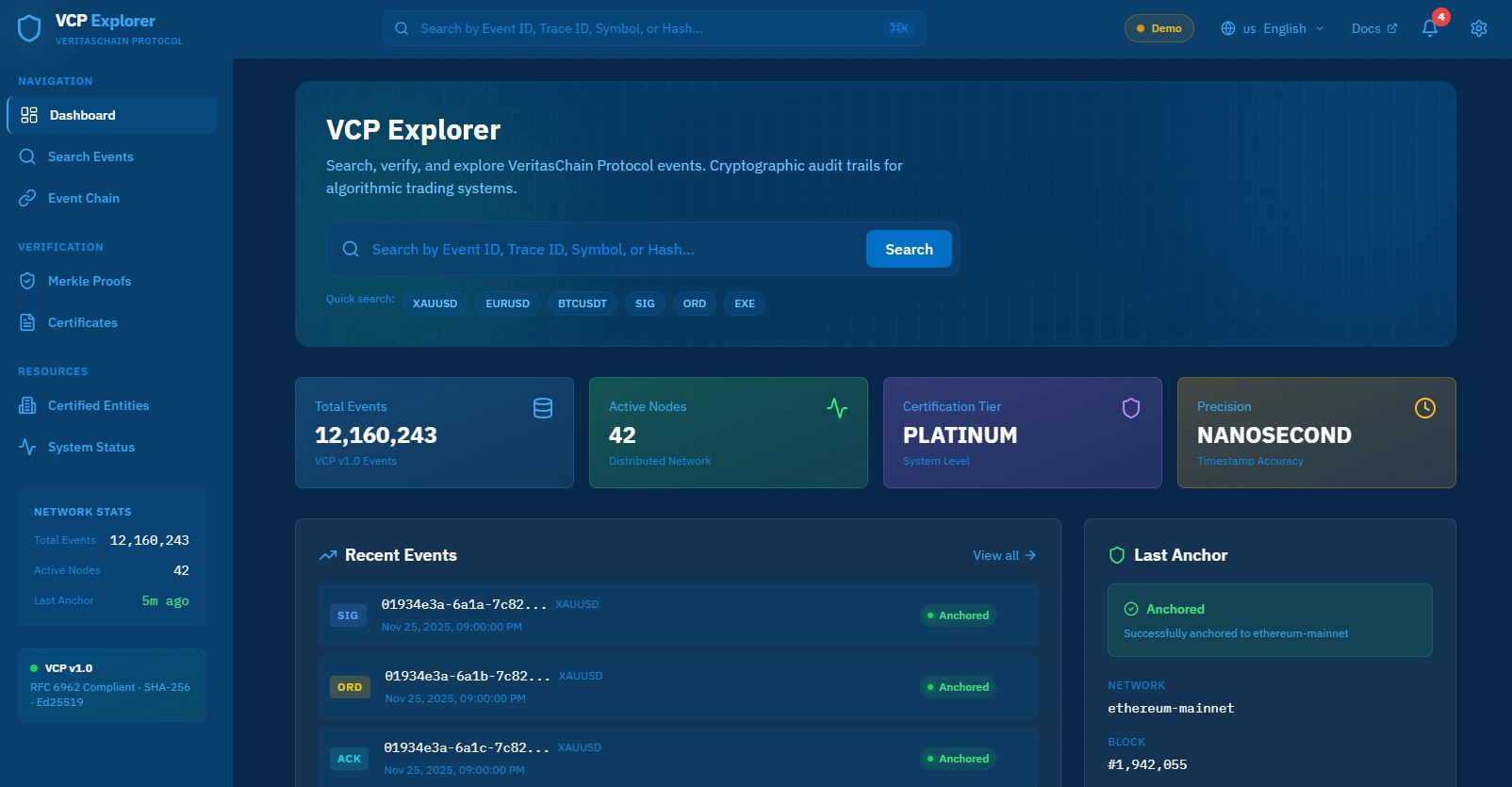
VCP Explorer — Cryptographic Audit Dashboard
A demonstration dashboard, running on simulated sample data, that shows how independent, cryptographic verification of VCP records works.
No live trading system is connected, and the Explorer API is not yet deployed (Planned — no date set).
VeritasChain Protocol (VCP) is an open standard specification for recording the "decision-making" and "execution results" of algorithmic and AI-driven trading — including AI model versions, decision factors, time-synchronized event lifecycles, and cryptographically hashed audit trails — in a tamper-evident, append-only and verifiable format. VCP provides a cryptographically secured chain of evidence, designed to support compliance efforts with international regulations including MiFID II, EU AI Act, and CAT (Consolidated Audit Trail), making it a valuable tool for RegTech, Audit, and Compliance. VCP verifies the integrity and attribution of recorded events — it does not certify the correctness or safety of the underlying AI or trading decisions.
VCP also records:
In addition to the order and execution data that FIX messages carry, VCP defines records for:
AI model versions and decision factors
Active risk limits and triggered controls
Time-synchronized (PTP / NTP) timestamps
Cryptographically sealed audit trails
FIX standardises the messages exchanged between counterparties; it does not define a record of a system's internal decision factors or risk state.
This makes VCP relevant to evidence requirements under MiFID II RTS 25, EU AI Act Article 12, and next-generation RegTech.
Why VCP Matters to Regulators
Reconstructing algorithmic decision-making
Verifying timestamp integrity
Detecting tampering, and omission after anchoring
Producing evidence relevant to EU AI Act Article 12 logging obligations
Verifying best-execution evidence
Why Now?
VSO's position is that oversight of algorithmic and AI-driven trading should rest on records that can be verified independently. The rules below require record-keeping, event logging or clock synchronisation; none of them mandates cryptographic audit trails or refers to VCP.
EU Clock Synchronization (formerly MiFID II RTS 25)
Requires business clocks traceable to UTC, with specified accuracy, for trading venues and their members and participants in the EU (Delegated Regulation (EU) 2025/1155, Arts. 11–16; replaced RTS 25 on 2 March 2026)
EU AI Act (Regulation (EU) 2024/1689)
Requires automatic event logging (Art. 12) and human oversight (Art. 14) for high-risk AI systems; Annex III obligations apply from 2 December 2027
CAT Rule 613 (Ongoing)
U.S. SEC's Consolidated Audit Trail requires granular trade lifecycle tracking
VCP provides a single open standard that produces evidence relevant to all these requirements, reducing fragmentation across jurisdictions — by design.
Tamper-evident audit trails using Merkle trees (RFC 6962 domain-separated hashing) and external anchoring; hash chains are optional
Crypto Agility
Ed25519 by default, upgradeable to post-quantum algorithms including ML-DSA (FIPS 204)
Each signature carries its algorithm identifier, so algorithms can be changed. Post-quantum signatures are EXPERIMENTAL in VCP v1.2.0 GA (tag v1.2.0, commit b23acb266f88df81d960d36d58fb64ceaa0dd5ed; GA merged 2026-10-08 JST; fix merged 2026-10-09 JST) and are not a certification requirement. This is the VCP release status, separate from VAP v1.2.0 Draft 3.
Regulatory Evidence
Designed to produce evidence relevant to MiFID II RTS 25, EU AI Act, GDPR, CAT Rule 613, and international reporting
Multi-Tier Support
Compliance tiers for HFT (Platinum), Institutional (Gold), and Retail (Silver).
Note: Silver Tier relies on system time (Best-effort) and delegated signatures. It provides transparency, not regulatory-grade evidence.
FIX Protocol Integration
Side-car integration with existing FIX engines — no change to trading gateways required
Open Standard
Fully open specification with public reference implementations. Designed for long-term interoperability across brokers, exchanges, and regulators.
Verifiable Completeness
Split-View Attack and Omission Attack resistance (v1.1). Designed so that removing events from an anchored batch, or showing different records to different parties, is detectable.
AI Governance Logging
Records algorithm identity and version, a model hash, decision factors and approval records (VCP-GOV). Where a system is classified as high-risk under the EU AI Act, such records are evidence relevant to Article 12 record-keeping; algorithmic trading is not listed in Annex III.
SBE or FlatBuffers (Platinum) / JSON (Gold, Silver) Kernel bypass, RDMA and zero-copy are techniques the specification names for Platinum implementations
6. Integration
FIX Protocol Sidecar
Use Cases
Regulatory Authorities
Audit-trail verification, algorithmic decision reconstruction, and cross-border regulatory coordination
FX Brokers & Market Makers
Best-execution evidence, trade lifecycle verification, and verifiable records as input to regulatory reporting
Exchanges (Traditional & Crypto)
Transparent order matching, CEX audit trails, and cross-venue surveillance
HFT / Algorithmic Trading
Tamper-evident audit trails for high-frequency and algorithmic trading systems
Prop Firms & Hedge Funds
Verifiable trading records for payout and performance disputes
DeFi & On-Chain Proofs
Merkle root anchoring to public blockchains
Get Started with VCP
👨💻
For Developers
Integrate VCP into your trading infrastructure using the open specification, the SDK specification and the reference implementations
Industry-specific profiles for cryptographically verifiable AI audit evidence
VAP (Verifiable AI Provenance Framework) — which VSO describes as "the flight recorder for AI" — is the cross-domain upper-level metaframework (current: v1.2.0 Draft 3) that defines the structural requirements for cryptographically verifiable AI decision provenance. Its scope is deliberately strict: domains where system failure could cause serious, irreversible harm to human life, societal infrastructure, or democratic institutions. Finance, healthcare, transportation, energy, and public policy are VAP's mandatory application domains; content/creative AI and capture provenance are served by released profiles. VAP itself is not an implementation — domain profiles apply its requirements to a sector. Status in the VAP registry (§4.5.2): VCP v1.2 Released; CAP v1.0 Released; CPP v1.4 Released; OAP v0.1.1 Working Draft; MAP v0.1.2 Working Draft; PAP Partial Draft (Track B v0.2.0); IAP Announced; DVP, AAP and EIP Planned (no specification document exists for IAP, DVP, AAP or EIP). Read the VAP Framework overview →
VeritasChain Co., Ltd. is a technology company developing open cryptographic audit and provenance standards for algorithmic and AI-driven trading, enabling regulators, institutions, and markets to verify—not merely trust—system behavior.
VAP (Verifiable AI Provenance Framework) defines shared requirements for verifiable records of AI decisions and actions. The published framework is v1.2.0 Draft 3; it is a draft, not a certification of an AI system.
How are VAP and VCP related?
VAP sets cross-domain requirements. VeritasChain Protocol (VCP) is the financial domain profile for algorithmic and AI-driven trading records. Other profiles address different domains.
What can these records prove?
Cryptographic evidence helps verify the integrity and provenance of recorded events. It does not establish that an AI decision was correct, safe or legally compliant.
Where can I start?
Read the VAP framework for the shared requirements. For trading systems, explore the VCP specification and the verification demo using sample data.